

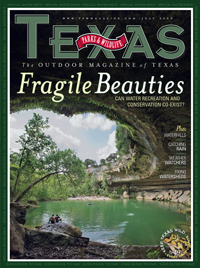
From the Pen of Carter P. Smith
If you have never read The Time it Never Rained by Elmer Kelton, I heartily recommend it for your summer reading list. As Kelton does arguably better than anyone, he offers up a poignant tale of the trials and tribulations of West Texas ranch life. The setting encompasses the drought of the 1950s and the ranch of a cantankerous and weathered West Texas stockman, Charlie Flagg, who struggles with keeping his ranch, family, and livestock together during a drought of record. It is a good read and another powerful reminder that in Texas, water, whether in plenty or in need, or whether in urban or rural places, concerns us all.
How we care for the future of our water is one of the most important facets of our work at Texas Parks and Wildlife Department. The fate of our fish and wildlife populations is inextricably linked to the vitality and quality of our aquifers, springs, creeks, rivers, bays and gulf waters. Quite simply, water means life. And nature’s biological cycles of breeding, nesting, laying, spawning, fawning, hatching and rearing all tie back to the ebbs and flows of our water, both in quality and in quantity. That is true, whether we are concerned with Guadalupe bass, redfish or Houston toads.
As the title of Larry Hodge’s article in this magazine suggests, the thoughtful management of our aquatic resources all begins with where the raindrops land. Thinking like a raindrop, as Aldo Leopold might have said, is an appropriate way for us to steward our precious aquatic resources. To do this, we must approach water holistically and manage it from the aquifers to the estuaries. The logic of such a watershed-based approach is inescapable.
For if the rangelands on which the raindrops fall are not well managed, our aquifers will not recharge. And, if our aquifers are not sufficiently recharged, our springs will cease or diminish in flow. And, if our springs are diminished, our creeks, streams and rivers will flow with less vigor and less permanence. And, if the flows in our creeks, streams and rivers are diminished, there will be less freshwater contributing to the health of our bays and estuaries.
The consequences of insufficient freshwater reaching our bays and estuaries, irrespective of the cause (natural or human induced), may be manifested in a number of ways. Last winter for instance, it was illustrated by the loss of approximately 8 percent of the whooping crane population that winters along the mid-coast, in and around the Aransas National Wildlife Refuge. Without adequate freshwater inflows, blue crab populations were reduced substantially. The blue crabs are a staple of the whooping cranes diet. Without their primary food source, the cranes were stressed nutritionally, and regrettably, an alarming number perished as a result.
As Texans we all have a role to play in managing our aquatic resources. Whether we know it or not, we all live in a watershed. The raindrops that fall in our lawns, fields, woods and pastures ultimately either replenish an aquifer or flow into a creek or stream. As a result, the actions we take and the decisions we make with how we use, manage, conserve and value water impact the needs of those downstream, including our fish and wildlife.
I hope you enjoy this issue about all things water. If nothing else, I hope it helps you think a little more about where that next raindrop lands and where it might end.
Thanks for caring about Texas wild places and wild things. Our aquifers, springs, creeks, rivers, bays, estuaries and gulf waters need you more than ever.